
Why we run our own store before we run your ads
Operating store.solifein taught us more about conversion than any course. Here's what eating our own cooking changed.
A shop owner in Lucknow asked me a question last year that I didn't have a clean answer to.
I'd finished the usual pitch — reach, creatives, targeting, the whole thing. He listened politely. Then he said: "Aap ne kabhi apna paisa laga ke apna saaman becha hai?" Have you ever put your own money in and sold your own product?
Not a client's money. Mine.
The honest answer at that moment was no. So we went and fixed that.
We built a store we actually have to answer for
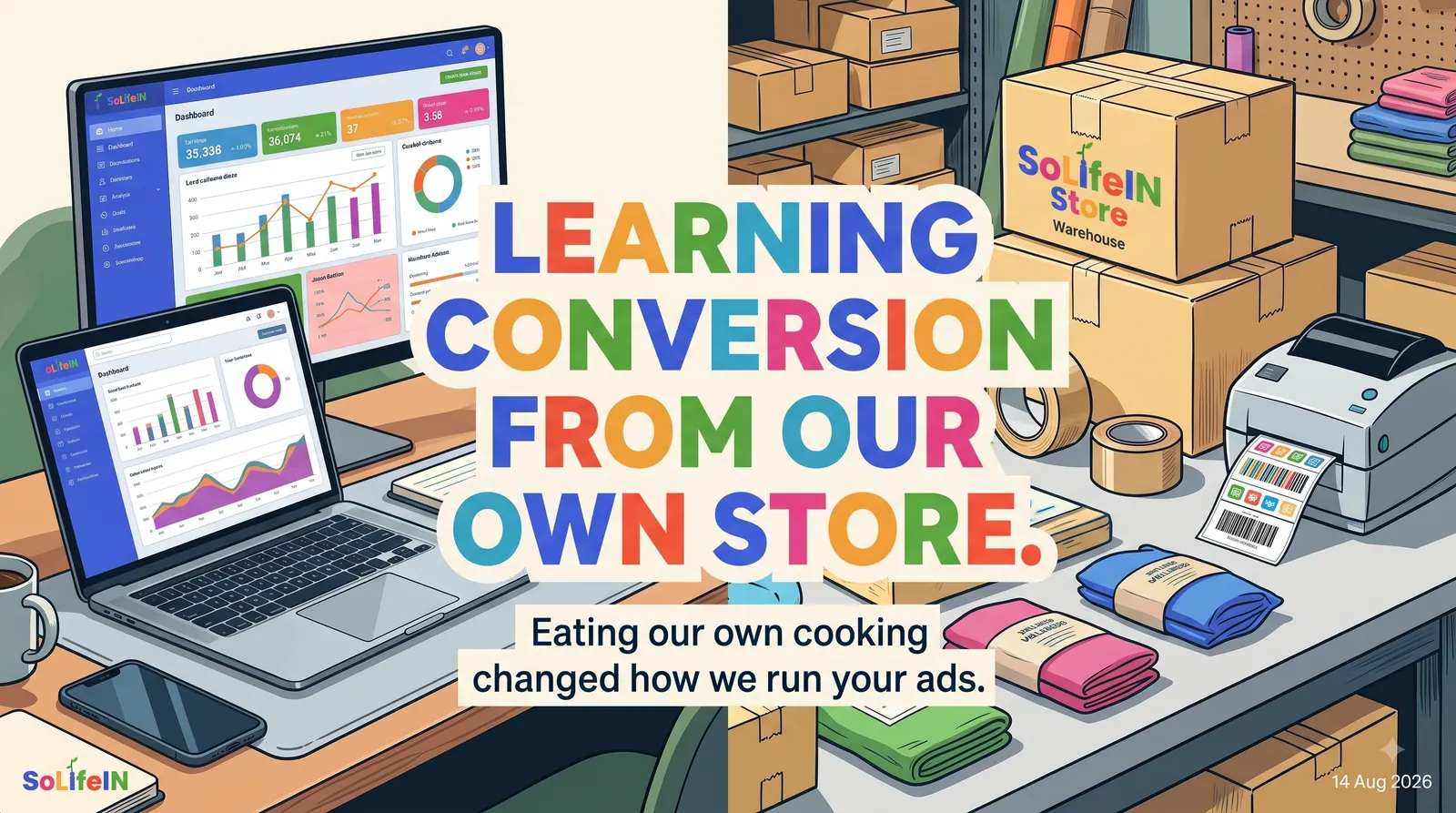
To be clear about the two things, because people mix them up: solifein.com is the agency — this site, where we do brand, web and marketing work for other people. store.solifein.com is our own shop, stocking Ayurveda and wellness, clothing and books. Our inventory. Our packaging. Our returns. Our angry customer at 9pm on a Sunday.
It isn't a demo. That's the whole point. A demo can't teach you anything, because nothing goes wrong in a demo.
Running ads with someone else's money teaches you media buying. Running a store with your own money teaches you where the money actually leaks.
Four things the store taught us that no course did
1. Traffic was never the bottleneck. Checkout was.
Getting people to the store turned out to be the easy half. Getting them from "added to cart" to "order confirmed" was where we lost them, and it had almost nothing to do with the ad creative. It was load time on a mid-range Android phone on a patchy connection. It was a form asking for things nobody wanted to type. It was one more tap than necessary.
We now check that before anything else, because there is no point paying to send traffic into a leaking bucket.
2. Cash on Delivery changes the entire maths
This is the part imported playbooks skip completely, and it's the part that matters most in India. When a meaningful share of your orders come COD, an "order" is not revenue yet. It's a promise. Some of those parcels come back — RTO, return to origin — and you've paid forward shipping, return shipping and packaging for an order that earned you nothing.
Which means a campaign can look excellent on the dashboard and still lose money in the bank account. We learned that on our own P&L, not a client's.
3. UPI, pin codes and the delivery promise
A checkout without a clean UPI path is leaving money on the counter. A product page that promises delivery to a pin code your courier partner doesn't reliably serve is generating a refund, not a sale. We got both wrong before we got them right, and we got them wrong on our own store, which is exactly where we'd rather get things wrong.
4. Indian buyers are looking for reasons to trust you
The things that moved the needle on our product pages weren't clever. A real phone number. A stated return window in plain language. A proper GST invoice. Photographs of the actual product instead of stock images. Legal and policy pages that exist and say something.
Those pages aren't decoration, incidentally — payment gateways ask for them during onboarding. Skip them and you don't get to take money at all.
What this changed about how we work with clients
Our order of operations now
- We look at your store before we look at your ad account.
- We won't start paid campaigns for a store that can't reliably take, fulfil and keep the money.
- We report on delivered, kept revenue where we can measure it — not just ROAS on a dashboard.
- We fix checkout, trust signals and policy pages first, because they cost less than ads and compound.
Sometimes this loses us a month of billing at the start. We think that's the right trade. An agency that starts spending your budget on day one is optimising for its own invoice, not your bank balance.
And the things we won't claim
Since this is a build log and not a brochure, a few limits worth stating out loud:
- We are not Myntra, and we won't pretend to be. We study the big platforms as design benchmarks. We don't quote them as deliverables.
- We don't say "all-India supply" until there's a signed logistics partner behind it. A capability you can't deliver is a refund waiting to happen.
- We don't inflate numbers. If we haven't measured something, we say so — including in this post.
- Regulated categories need real care. Ayurveda and wellness claims, in particular, come with rules. We'd rather write cautious copy than clever copy.
If you're building something in Lucknow or anywhere in UP
We're a Uttar Pradesh company — SOLIFEIN SOLUTIONS PRIVATE LIMITED, registered in Jhansi — and most of the businesses we talk to are within a few hours of us: Lucknow, Kanpur, Agra, Jhansi, Varanasi. Small manufacturers, single-shop retailers, family brands with a good product and no way for anyone outside the district to buy it.
If that's you, the most useful thing we can offer isn't a pitch. It's a second pair of eyes on the thing you've already built.
Send us your store. We'll tell you what's leaking.
Share your store link — or your Instagram, if the shop is still in your DMs — and we'll come back with the specific things costing you orders. Checkout, trust signals, delivery promise, policy gaps. No deck, no obligation, and we'll tell you if you don't need us yet.
Or reach us directly: info@solifein.com · +91 91961 81314 · @solifein
Written by Divesh Agarwal, Director at SoLifeIN. We're still running the store, so this post will get updated as we get things wrong in new ways.