
The Indian D2C starter playbook
Launching a small Indian brand on a tight budget: the channels, the order, and where not to waste your first ₹50,000.
In the last post I said we'd tell you how we spend a client's first ₹50,000. This is that post.
Fair warning: it's less exciting than most launch advice. Nobody goes viral in here.
Two rules before you spend a rupee
The order matters more than the amount. Two brands can spend the same ₹50,000 and end up in completely different places, purely because of what they bought first. Spending on ads before the store can convert is the most expensive mistake available to a small brand, and it's the most common one.
Your first ₹50,000 is tuition, not growth. You are not buying sales. You are buying information — whether strangers will pay full price, which product they choose, and what it actually costs you to deliver one order and keep the money. Budget it like a course fee and you'll make better decisions than if you budget it like a revenue target.
If ₹50,000 has to produce profit, it won't produce learning. And learning is the only thing at this stage that compounds.
Weeks 0–2: spend nothing
Before any of that money moves, get to your first ten orders without advertising. Not ten orders from your family — ten from people who had to be convinced.
WhatsApp Status, your own Instagram, local groups, one market stall, a friend's shop counter. It is slow and slightly embarrassing and it is the most valuable fortnight of the whole launch, because it answers the only question that matters: will a stranger pay full price for this?
If ten people won't, ₹50,000 of advertising will get you to that answer more slowly and more expensively.
Where the ₹50,000 goes
| Line | Amount |
|---|---|
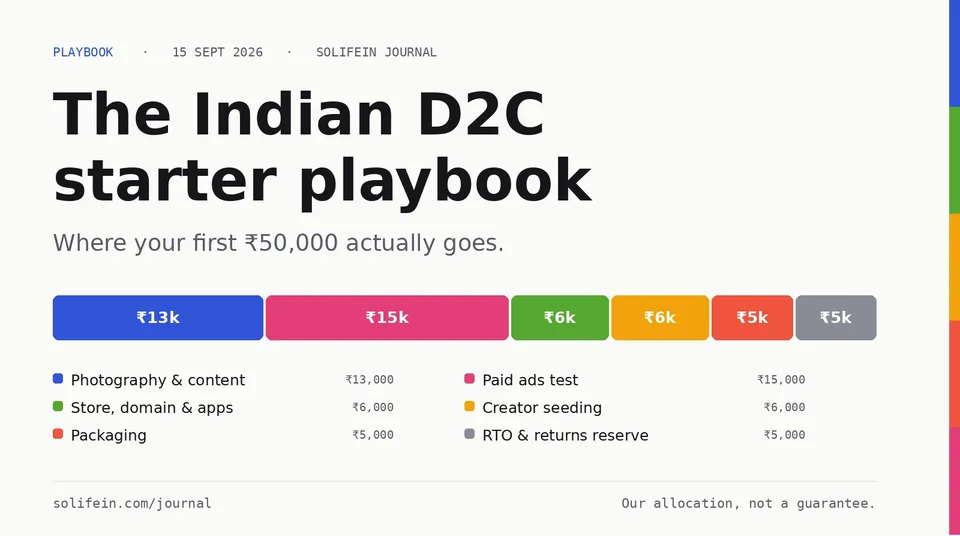
| Photography & content15–20 assets shot in a single day. Your photos have to do the job a shop assistant does in person. | ₹13,000 |
| Paid ads testDeliberately last in the sequence. Split across retargeting and one cold test, not one big campaign. | ₹15,000 |
| Store, domain & appsDomain, one clean theme, and only the apps you'll actually open. Every app is a monthly bill and a slower page. | ₹6,000 |
| Creator seedingThree to five micro creators. Send product, not cash. Cash buys one post; product sometimes buys a customer. | ₹6,000 |
| PackagingUnglamorous and worth it. The unboxing is the only physical contact your brand gets. | ₹5,000 |
| RTO & returns reserveMoney set aside for parcels that come back. Almost nobody budgets this. It is the line that decides whether month two hurts. | ₹5,000 |
| Total | ₹50,000 |
This is our allocation, not a rule of nature. A brand with an existing audience should move money out of content and into inventory. A category nobody understands yet should move money out of ads and into education. The shape shifts. What shouldn't shift is that ads come last.
The channel order
1. WhatsApp, before anything else
It's already installed on your customer's phone, it costs nothing to start, and the intent is higher than any ad platform will give you. A broadcast list of 200 past buyers outperforms most first ad campaigns. Start collecting numbers from order one.
2. Instagram, organically
Not for reach — for proof. When someone sees your ad and taps through to a profile with four posts and no replies, they leave. The profile is where the sale is lost or saved.
3. Meta ads, retargeting first
Retarget people who already visited before you pay to find new ones. It's cheaper, it converts better, and it tells you whether your product page works before you scale spend against it.
4. Google Search, only if people search for your category
For "ashwagandha capsules" there's existing demand and Search is excellent. For a product nobody has a name for, there's nothing to bid on. Check the demand exists before you build for it.
5. Marketplaces, later and knowingly
Amazon and Flipkart bring volume. They also take fees, own the customer relationship, and train you to compete on price. Fine as a second channel. Dangerous as a first one, because you'll build a business you don't own.
Skip entirely, for now
- One large influencer for one paid post. You cannot afford enough repetition for it to work.
- SEO blog content. It pays back over months. You need answers in weeks.
- Discount codes in month one. You'll train your first cohort never to pay full price.
- A logo redesign before ten customers exist. You're guessing at an identity for people you haven't met.
- Inventory deeper than proven demand. Stock is the quietest way to lose your launch budget.
Three numbers, from day one
Contribution margin per delivered order. Selling price minus product cost, shipping, packaging, gateway fee, return cost and discount. Not revenue. Not ROAS. This is the number that tells you whether you have a business.
Cost per delivered order. Not cost per order. If your ad platform reports 100 orders and 22 come back, your real cost per order is a quarter higher than the dashboard says.
Repeat rate at 60 days. D2C economics live or die on the second purchase. A brand where nobody reorders is a brand that has to buy every single customer forever.
Two admin things that stop launches dead
Your policy pages gate your payments. Shipping, returns, refunds, terms, privacy and a contact page with a real address — payment gateways ask for these during onboarding. Founders discover this in week four, with inventory sitting in the room. Write them in week one.
Sort your GST position before you list anywhere. Marketplaces will ask for a GSTIN, and registration thresholds and the rules for selling through e-commerce operators have changed more than once in recent years. This is a twenty-minute conversation with a CA, and it is not a conversation to have from Google. We're a marketing company, not your accountant — we'll say that plainly rather than guess at your liability.
What ₹50,000 will and won't do
It will not make you profitable. Anyone who tells you it will is selling a course.
What it will do, spent in this order, is tell you whether the next ₹5,00,000 is worth committing — and where to point it. That is a genuinely valuable thing to know, and most brands spend a great deal more than ₹50,000 without ever learning it.
One advantage of building from Lucknow
We're in Lucknow, and most of the founders we work with are in UP — Kanpur, Agra, Jhansi, Varanasi. There's a real cost advantage here that nobody talks about. A product shoot that runs ₹40,000 in Mumbai runs a fraction of that with good local photographers, and the studios are not booked out three weeks deep.
Your ₹50,000 is simply worth more here. The disadvantage is distribution and delivery timelines, which is a solvable problem. Spend the difference on better photography and deeper testing, not on a fancier logo.
Tell us your product and your budget. We'll tell you the order.
Send us what you're selling and what you have to spend, and we'll come back with the sequence we'd actually run — which line goes first, which channel to ignore, and what your numbers need to look like before you scale. If your money is better spent on inventory than on an agency, we'll tell you that too. We've said it before and kept the relationship.
info@solifein.com · +91 91961 81314 · Instagram · LinkedIn · YouTube · X
Previously: Why we run our own store before we run your ads — what operating store.solifein taught us about conversion, COD and returns.